- Revenue Diaries
- Posts
- Revenue Diaries Entry 68
Revenue Diaries Entry 68
Tips to Not Get Fired Part 2: Good Taste and Strong Team & Culture

Kyle Lacy
April 12, 2026
Cheers everyone! We are back to another week, and to the Don’t Get Fired series I started at the beginning of March. This week’s is about team and culture. I’m digging into the kind of leadership habits that shape a team over time:
Being clear from day one
Pushing people to make decisions without constant permission-seeking
Protecting good taste when everything is moving fast, and the easiest option is usually the most forgettable one
The topic was further cemented after a coaching conversation I had this week. It started as a conversation about goals and performance, and shifted to managing expectations on a team, how to help people take more ownership, and how to know when someone is truly aligned versus when they are just nodding along in the meeting.
The longer I do this work, the more I think leadership is mostly translation. Taking something that feels obvious in your head and making it clear enough that another person can actually act on it.
That matters because so much tension on teams comes from people operating with different versions. And when it’s lost in translation, everybody gets frustrated when the outcomes do not line up.
The best teams in the biz have figured out what good looks like, and the rules of engagement to get it done. They know when to move, when to ask, and when to trust their own judgment. That kind of clarity creates accountability because it is hard to hide behind confusion when expectations are clear.
And that’s where culture really gets built, and with a strong culture, it’s so much harder to get fired as a CMO. 🙂
So this week’s article is about that. The kind of leadership habits that make a team more confident, more decisive, and a lot less dependent on constantly trying to interpret the worst offender: you.
♥️ kyle

Don’t Get Fired: Team & Culture
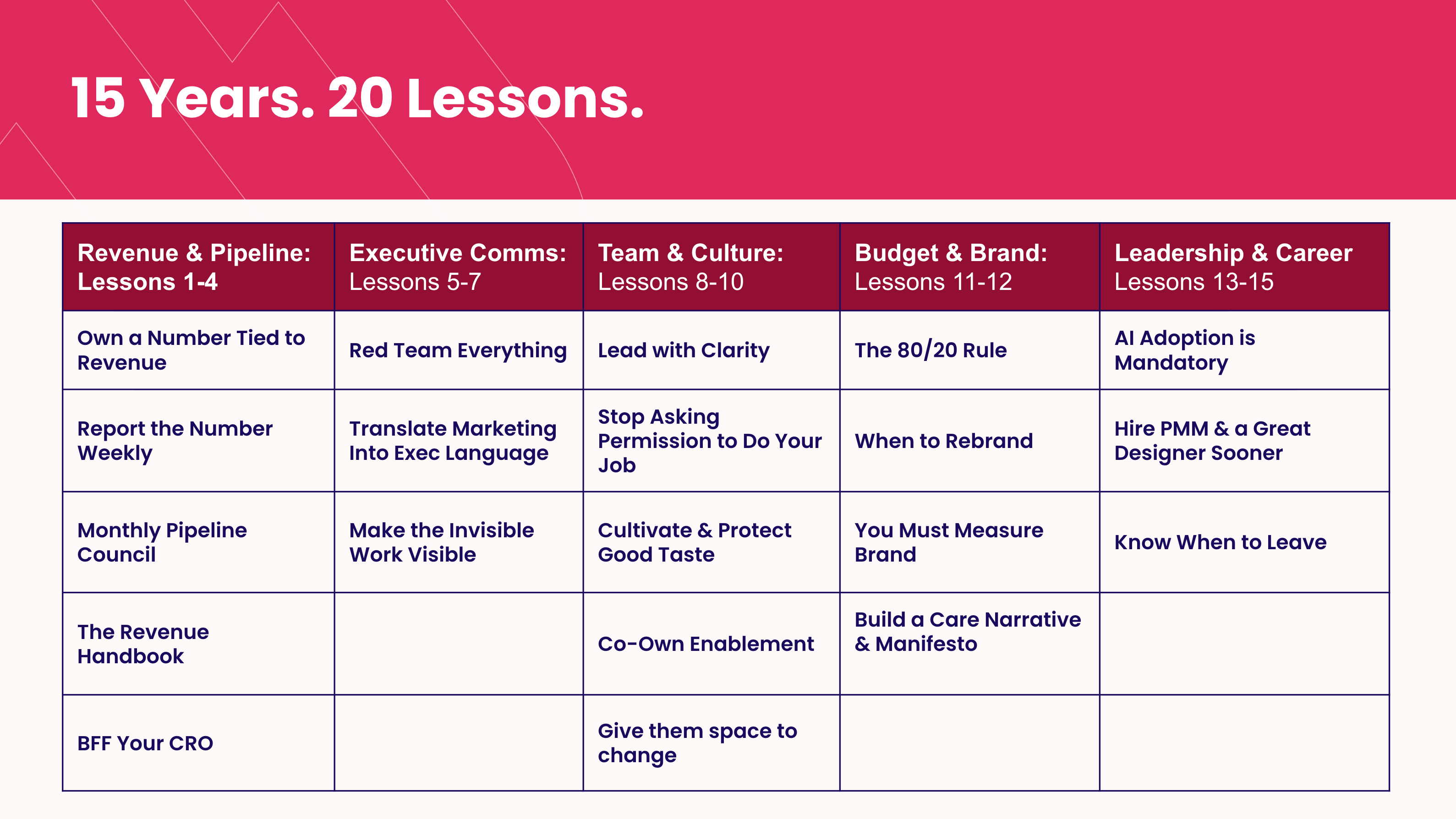
If you remember way back when GPT and Claude were half as powerful (last month), I wrote about the different lessons I’ve learned over the last 15 years of running marketing teams. I took a bit of a hiatus to cover my first year at Docebo, and honestly, some of those lessons overlapped anyway.
So, now we are back to the “Don’t Get Fired” series, which pulls from 20 lessons I’ve learned over the last 15 years running marketing teams.
Entry 66 covered Revenue & Pipeline, owning a number, reporting it weekly, running a pipeline council, and building the infrastructure that gives marketing credibility at the executive level.
Today, I thought we’d dive into Team & Culture. Specifically, the first three lessons: leading with clarity from day one, stopping the permission-seeking, and cultivating taste when everything is running like a freight train.
Lesson 1: Leading with Clarity
When I joined Docebo as CMO, the first week was an absolute blur, mainly because it was our user conference. No better onboarding tool than a massive event with our best prospects and customers. Haha. Needless to say, I remember almost ZERO of what happened the first couple of weeks.
But I had really only two goals: learn as much as possible from our customers and start building relationships with the marketing team. And the latter started with a welcome email.
I wanted it to be different from the usual fluffy, bullshit hello they’ve received from other marketing leaders. I didn’t want a “look at my long career” or “here’s a specific 90-day plan you need to follow.”
I made it simple. Here’s where I stand. This is what I believe. And last but certainly not least, my expectations on how we’ll work together.
It’s super important to do this if you are new to the team or company. I truly believe that silence, and lack of communication does more damage, especially when a team has already been through a ton of change. And most teams have. Your team doesn’t need your full plan in week one. They need some direction while you earn their trust.
Here’s part of what I sent, and explained my expectations of the team:
Own a Number. We're not here to make noise. We're here to generate pipeline and revenue. That's how you earn a seat at the table. That's how you have a voice in the business.
Share Before You're Ready. Don't wait for perfect. Get feedback early. Let others sharpen your thinking. Progress beats polish. When we share early, we learn faster and ship better.
Build Trust. Brand is what people feel when they see our name, visit the site, hear a pitch, or use the product. Every touchpoint matters. If it's off, slow, or sloppy, it hurts. Great marketing is consistent, clear, and intentional. It builds trust and drives pipeline. It's an asset. Treat it like one.
Improve Every Week. Sharpen how we write, plan, measure, and execute. Use the tools. AI won't replace the work but should make it faster and sharper. Share what's working. Keep learning.
Make Time for Life. I burned out in another chapter of my career. It's not worth it. Work matters, and so does your health, your family, and your time. I want this to be a team that does great work and still has a life. Both things can be true.
Make the Customer the Hero. Our best marketing is their story. Talk to them, learn from them, and share their wins.
And I was clear about what the team should expect from me. I'll be clear on what matters and why. I'll move fast, and I'll expect the same. I'll care more about results than polish. I'll be direct. I'll ask you to own your work, and I'll own mine.
There are plenty of ways to lead with clarity, but I’ll never start a new role or build a new team without sending the “clarity” email first. Building the right culture starts with behavior, and you can only build the right behavior with clarity.
The first note sets the stage, don’t waste it.
Lesson 2: Stop Asking for Permission to Do Your Job
I’ve had plenty of coaching conversations with my management team and skip-level managers over the years. Only god knows how many topics you cover over the course of a career, but there is one conversation I’ve found that spans every company: it’s about decision-making.
There’s a reason you were put in this role. There’s a reason you got the promotion. There’s a reason you’ve been given more responsibility. There’s a reason I hired you.
You’ve done the work to build trust. Now, it’s important you use it. And many leaders don’t, which absolutely blows my mind.
Let’s look at an example:
The wrong way:
CMO: "Hey, I wanted to run something by you. We're thinking about sponsoring this conference in Q3. I wasn't sure if you'd be okay with it, so I wanted to get your thoughts before we moved forward."
CEO: "What's the audience?"
CMO: "It's mostly mid-market HR leaders. Pretty close to our ICP."
CEO: "How much is it?"
CMO: "About $40k. It's in the budget."
CEO: "Then why are you asking me?"
The right way:
CMO: "Heads up! We're sponsoring this conference in Q3. $40k, in the budget. The audience is mid-market HR leaders which maps directly to our ICP, and I think it's the right move for pipeline in that segment. I'll send you a recap after."
CEO: "Sounds good."
Same decision. Same budget. Thirty seconds instead of three minutes. Nothing but net. 🙂
When you ask permission for decisions that are already yours, you're telling your CEO they might have hired the wrong person. And you're telling your team that they need to do the same thing with you.
Permission-seeking cascades downward. It's a waterfall of emotions, my friend. :)
Here's how to fix it. You need to be able to draw the line. Where do you have to make the call? Where can they make it themselves? Don't make your team guess where their authority starts and stops. Don't make your boss wonder whether you'll check in before every decision.
Imposter syndrome never fully goes away. I won't pretend it does. But the cost of being wrong occasionally is lower than the cost of never actually leading.
Make the call. Own it. Adjust if you're wrong. That's the job.
Lesson 3: Cultivating & Protecting Good Taste
In January of this year, we compressed three major initiatives into a three-week timeline.
We launched a new brand.
The next week, we hosted Revenue Kickoff with hundreds of teammates in Atlanta. And that same week, we announced the acquisition of 365Talents. All of it, layered on top of each other, running simultaneously.
It was wild.
I'm not sure I've ever witnessed the sheer volume of work thrown at a team in that short a window. We had plenty of late nights, early mornings, and frantic moments where we screwed up, things broke, and needed to be fixed in real time.
When you are moving at 100 miles an hour, and the pressure is relentless, the easiest thing in the world is to reach for a shortcut. And we have a pretty powerful shortcut at the tips of our biologically limited fingers: the robots.
AI can generate a blog post in thirty seconds. It can spin up a campaign concept, write the copy, and produce the creative brief before you've finished your coffee. The temptation to just... let it run... is real. And a lot of teams do exactly that.
And most of the time, the output is crap.
Blog post that sounds robotic? ✅
Social image that looks stock, but isn’t (which is weird): ✅
AI slop is everywhere right now, and it's only going to get worse. Unless you cultivate good taste. The judgment to know the difference between something that's done and something that's actually good.
Everyone has access to the same tools now.
The same LLM models, content generators, copy prompts, Claude Skills, and design assistants. Which means the floor for marketing output has never been lower... and the ceiling for genuinely good work has never mattered more.
The only real competitive advantage a marketing team has is taste, because B2B marketing is almost universally boring, and the bar is so damn low. And it’s only going to get lower.
Because the temptation to use our new robots/AI to scale is strong when things are moving fast. And, let’s be honest, it never slows down.
AI tools done the wrong way give permission to ship work that's underwhelming because at least it's done. It’s important that we try not to do that. We obsess over the experience. We stare at the thing a little longer than feels comfortable and ask whether it's actually good.. because it’s probably not.
It’s about protecting taste and that’s your job as the leader. It’s about giving your team explicit permission to spend a little more time in reflection before shipping something.
Taste is valuable, and if you don't name it as a value, the pressure of speed and volume will erode it every time. There are some that will default to done over good when they don't have clear signal that good matters. So you have to say it out loud, then model it yourself.
Expose your team to great work outside your industry. Make it a practice. DTC brands. Consumer campaigns. Design studios. Great film posters. Anything that raises what they think is possible. When your frame of reference is only B2B SaaS, you end up producing B2B SaaS work.
Boring is always a choice. It's usually the easier one. But it's a slow death for a brand, and for the people on your team who got into this work because they wanted to make something worth making.
The team at Docebo came out of that brutal three-week stretch with trust intact, work we were proud of, and people who wanted to do it again. That doesn't happen by accident. It happens because I made the standard clear before the pressure arrived. And I repeated it constantly.
NEED A WRAP UP