- Revenue Diaries
- Posts
- Revenue Diaries Entry 66
Revenue Diaries Entry 66
How to Not Get Fired: 15 Years and 20 Lessons Running Marketing

Kyle Lacy
March 08, 2026
My oldest, Caden, just had his first overnight, where he didn't call to be picked up.
Not once. Didn't text. Didn't ask to come home early, which he has the past two times. He lived the good life without needing us. And I want to be very clear: this is exactly what you want as a parent. You work toward this moment. You should celebrate it. I did… kind of.
But also, it was a little sad.
There's something about watching your kid not need you for the first time that you can't really prepare for. I kept picking up my phone expecting a call or text that never came. He was fine. More than fine, apparently. He pulled his first all-nighter, which will have ramifications this afternoon, but I digress.
I guess it felt like a mix of pride and grief. He is turning into his own person; he doesn’t need us as much. He’s growing into who he’s going to be, and it’s happening whether we like it or not.
It’s a similar feeling I’ve had this past week, around two things that are otherwise pretty different: what AI is doing to disrupt everything we know about marketing, and reviewing the last 15 years of my own career.
Both feel like they're moving at a pace I can't fully control. Both are making me ask the same question: what actually matters when time is moving this fast?
And it all came to a head on Thursday, when I taught the first class of the Pavilion CMO School. This year, I'm the dean (not sure if you capitalize it, but whatevs) and I had the pleasure of teaching the first class. But the question was, “What should I teach?”
How about all the lessons I’ve learned over the last 15 years of building and growing marketing teams?
Great idea, Kyle. Great idea.
So I built a session called "Don't Get Fired." 20 lessons across 15 years. The class went well, but I also realized that a 60-90-minute class isn’t going to tell the full story.
So I'm turning it into a series here. One deep-dive per category over the next few weeks. That's what this edition is kicking off… some honest reflection on what I'd tell myself at the beginning of all of this, and what I think still holds up in a world that's changing faster than any of us expected.
Hopefully, Caden will read it at some point in the future. So yah, let’s get into it.
♥️kyle

On Owning a Revenue Number (And Why It's the Only Way to Matter)
I believe the CMO job is one of the hardest in high-growth businesses.
I don't say that to complain. I say it because I think most people (including many of my peers) underestimate how broad the job actually is. You own a brand. You own product marketing. You own creative. You own demand. You own internal comms. Depending on the company, you own events, partnerships, analyst relations, and whatever else the business can throw at you.
The depth and breadth are what I love about the job, but it’s also what makes it super difficult and dangerous.
Because when you own a lot, there’s a real risk you end up accountable for nothing. You're running fast, shipping work, building things... and when someone at the board level asks, "What does marketing actually drive?", you are at a loss, or you push back with, “Well, it’s hard to quantify because we do so much. Here, look at this slide deck.”
👀 👀 👀 👀 👀 👀
Spoiler alert: that doesn’t work.
I’d like to believe I figured this out earlier than most, but it wasn’t because I’m smart. I was just lucky enough to take my first VP of Marketing role at a company where the answer was easier.
At Lessonly, we were generating somewhere between 60-70% of all demand through inbound. The website, content, organic... it was the engine. Which meant when somebody asked what marketing was contributing to revenue, I didn't have to argue about attribution models or brand value. I had the number and the model the board trusted.
So, I doubled down on owning pipeline > revenue, which gave me the opportunity to run some fairly creative marketing campaigns: board games, golden llama mailers, Legos, and an entire clothing line / online store. We even used a briefcase full of fake money as a direct mail campaign.
That taught me something important: the CMO seat at the executive table, the board meeting table, the table where real decisions get made... it isn't granted because of your title. It's earned because you can speak the language everyone else at that table already speaks.
Owning a number doesn't mean you're reducing marketing to a lead factory. It means you understand that marketing's job is to be the context layer between every other team in the building. Sales has a point of view. Product has a point of view. Finance has a point of view. Marketing's job is to synthesize all of that and translate it into demand that moves the business forward. A revenue number is just proof that you're doing it.
Here's how I think about building that accountability in practice.

The Number Itself
Start with pipeline and bookings. Not MQLs in isolation, not impressions, not "brand awareness scores." Pipeline that sales can close.
If your sales cycle is under 90 days, a direct source attribution model is defensible and clean. If it's longer, you're working with pipeline assumptions: average sales price, sales cycle length, win rates by segment, coverage ratios. Work with finance and RevOps to build the model together. If you don't have enough data to be precise, state your assumptions clearly and give an educated guess. A model with visible assumptions beats a vague commitment every single time.

Then, bonus your team on a version of that number. Revenue marketing owns direct-sourced pipeline. PMM co-owns pipeline tied to the product SKU they support, plus product adoption metrics that tie to expansion. Brand, creative, events... they tie to overall pipeline and bookings. When your team understands their work connects to a real number, prioritization conversations get dramatically easier.

The Reporting Cadence
This is where most marketing leaders drop the ball. They own a number in theory, but they only talk about it quarterly. That's too slow. You need to be working the numbers WEEKLY.
Here’s a cadence that works:
Every Friday, pipeline numbers are updated in a shared dashboard owned by RevOps. Every Monday, the CMO and CRO review them together. Channel owners send short async updates structured around two questions: are we on track, and if not, what are we doing about it.
Once a month, I roll all of it up. Every async update, every Slack Canvas, I pull it together into a demand report and send it to the executive team as a memo.
Yep. A memo.
The format is simple: an executive overview that answers what's working and what's not, pipeline attainment for the quarter with a year-over-year comparison, and a look ahead at what we're building toward next month. If there are open questions from the exec team about how the pipeline is being produced, this is where those get addressed directly.
I’ve also CLAUDED IT (high-five). I've built a cadence where the raw material for that memo gets pulled automatically out of Slack. Channel updates, async notes, the weekly check-ins — it all feeds into a pipeline update I can write in a fraction of the time it used to take. The output is the same. The drag is gone.
That monthly memo leads directly into the Pipeline Council.
The Pipeline Council
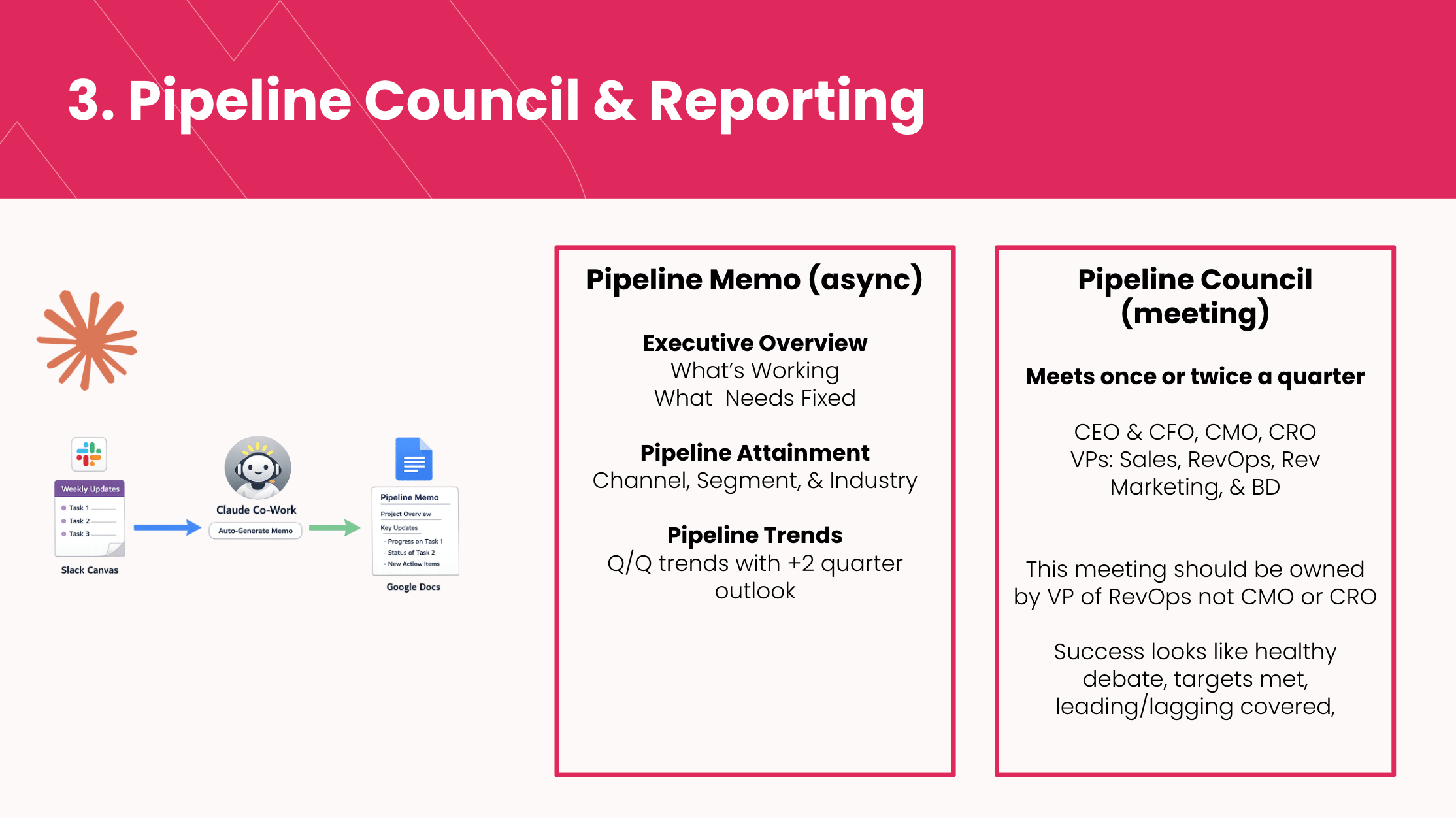
Once or twice a quarter, bring the right people into a room: CEO, CFO, CMO, CRO, VPs of Sales, RevOps, Revenue Marketing, and BD. Review pipeline attainment by channel, segment, and industry. Look at quarter-over-quarter trends with a two-quarter forward outlook.
One thing I feel strongly about: this meeting should be owned by RevOps, not marketing or sales. When marketing runs it, sales gets defensive. When sales runs it, marketing gets defensive. RevOps is Switzerland, which means the conversation can actually be about the pipeline rather than who's responsible for the gaps.
The Revenue Handbook
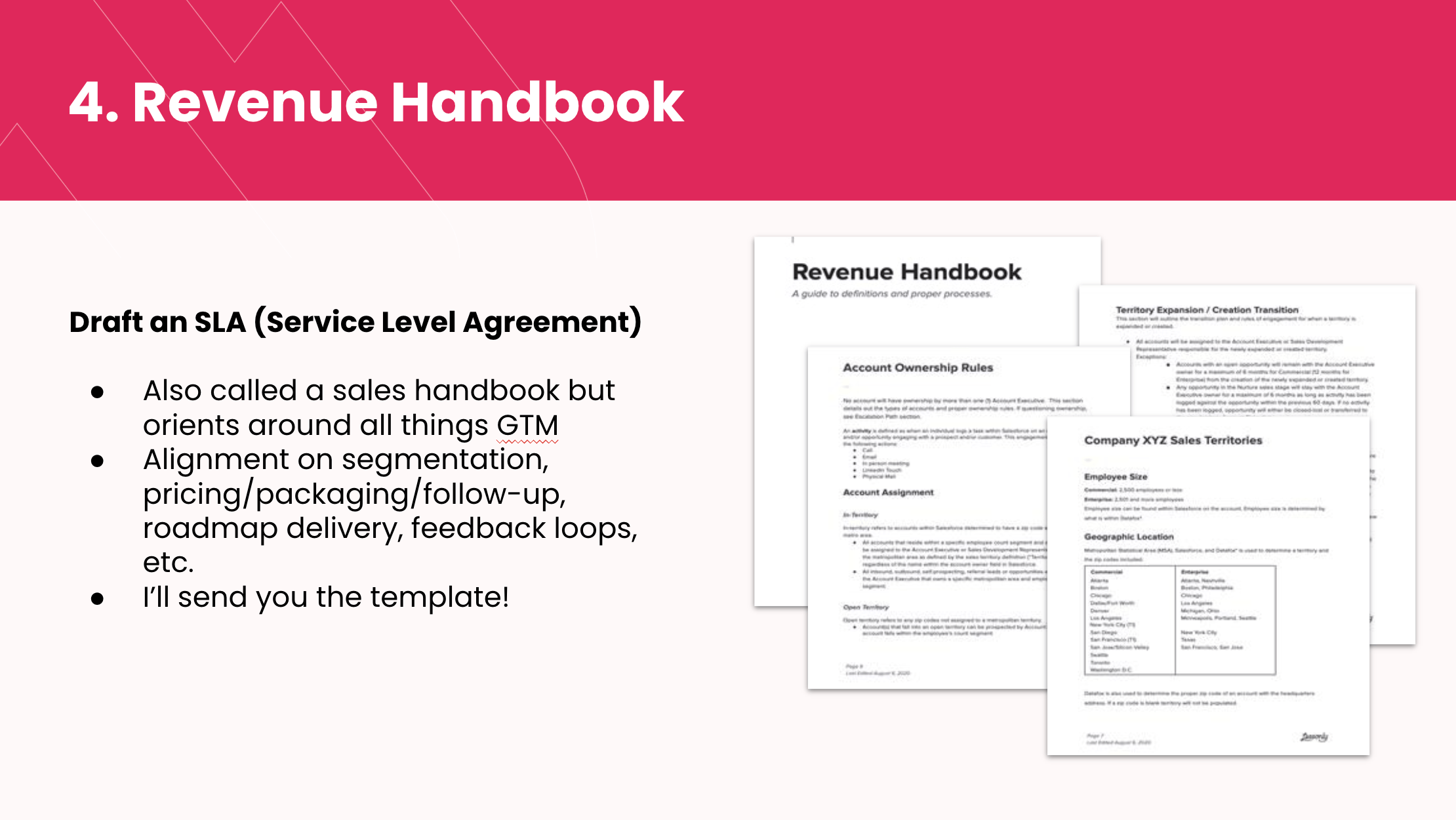
This isn’t a play I’ve used in every company. Sometimes it works, sometimes it’s not needed. It worked extremely well at Lessonly, and we don’t need it at Docebo because our sales team already has a process in place and it’s damn good.
But I highly recommend it for any company with a lack of alignment between sales and marketing. It's the written agreement between marketing, sales, and CS on how the GTM motion actually works. Segmentation definitions. Lead follow-up SLAs. What counts as a qualified opportunity. Who owns what stage. How territories work.
You get leadership sign-off on it. And then when things go sideways, and they will, you don’t blame anyone, you just look back at the agreement.
There's a reason I opened the Pavilion deck with this category. Not because the pipeline is more important than brand, culture, or leadership. But because credibility in a revenue-driven business comes from one place first.
You own a number. You know the number. You report the number. You close the gap when the number is wrong. What’s Working > What Needs Fixed
Everything else you want to build as a CMO, the brand work, the creative taste, the team culture, the trust with the board... it gets protected when you've already proven you can speak that language.
Next week: Executive Communication. Red teaming, making the invisible work visible, and how to translate what marketing does into something the rest of the company actually understands.