- Revenue Diaries
- Posts
- Revenue Diaries Entry 67
Revenue Diaries Entry 67
1 Year as a Public Company CMO & We Are All Searching for Something

Kyle Lacy
April 05, 2026
I can’t believe it’s already been a year since I joined Docebo as CMO. Wild.
One year in the seat. One year of writing about everything as it happens to me (and it’s alot). 100% overshared.
I’ve already made a handful of mistakes and collected a few big wins. We’ve done a lot, and still have so much more to do.
FIRST » A one-year reflection on what I actually learned as the CMO of a public software company, which you hopefully will never see in some LinkedIn guru’s playbook because I lived it.
SECOND » Is a deeply personal post about ambition, restlessness, and why most of us are hunting for something we may never find.
And like most things, they're connected, even if they don't look like it at first. One is about what you build. The other is about why you build it.
Hope you're having a good Easter Sunday.
♥️ kyle

1 Year as a Public Company CMO
One year ago this month, I walked into a new job with 15 years of leadership experience, a lot of strong but loosely held opinions, and the head trash that comes with any new job.
I’ve written a lot this year in real time, as the moments happen. Week after week, I tried to share what was actually happening without turning this newsletter into a highlight reel that’s damn boring.
But writing and understanding it are two completely different beasts, and here are the three lessons (of many) I’ve learned over the past 12 months as the CMO of a publicly traded company.
Always more to come, but for now, this is what year one actually taught me.
Lesson 1: No surprises, please.
The worst thing you can do as a leader is to surprise the people above you, beside you, and below you.
I've said this a hundred times: in Slack messages, coaching conversations, 1:1s, and in random convos with people at Revenue Kickoff. But as we learn from life's losses, saying it and actually laying the foundation to prevent it are two very different things. And that’s the first lesson from the past year: you need to build the infrastructure first.
I’ll give you a tangible example that starts with a question: What process/infrastructure do you put in place to proactively measure, report, and drive top-of-funnel pipeline?
Not reactive reporting, but proactive driving. Very different beasts, and one “surprises” the other “drives.”
Mark Kosoglow and I have spent an inordinate amount of time building and adjusting our pipeline reporting cadence. Is it perfect? No. Does it drive proactive change? Hell, yes.
Let’s break the damn thing down. Every week, our direct reports update their pipeline metrics inside Slack, async. It’s a structured update that we (senior leadership) can jump in and add commentary. Here’s the structure (straight from our Read Me documentation).
Weekly Cadence:
Every Friday (by EOD):
All pipeline numbers must be updated in the shared dashboard by RevOps
We will use a Slack canvas to track updates from pipeline owners
Updates are required every week, even if numbers are flat.
If you own a row of pipeline, you own the update.
Every Monday (by EOD):
Mark, Megan, and I review the Friday snapshot.
Any questions, risks, or gaps are documented directly in the canvas.
Unless otherwise noted, those questions are expected to be addressed in the next Friday update.
What Good Update Looks Like:
Don't belabor it, just short and direct updates:
1. Bottom line
On track or off track?
What are you pacing to vs. plan?
2. If something is off track
What’s broken or at risk?
What are you doing about it?
What should we expect to change over the next 1–2 weeks?
If you’re on track and nothing material has changed, a brief confirmation is fine. If you’re off track, we need details and expect you to report progress week over week until it’s resolved.
And the structure does something pretty amazing. When something goes wrong (and something always goes wrong), we're not finding out about it in a board meeting or an all-team meeting. We're finding it on a Monday, and by Thursday, we'll have already started fixing it. The surprise is gone. And without the surprise, the panic is gone too. You just... work the problem.
Mark and I built this together, which is super important in itself. When your CRO and CMO are pulling from the same context every single week, you stop having the "I thought you said..." conversations. You stop having the debates that are really just arguments about whose memory of the data is more accurate. And god knows, Mark beats me on the memory game every damn day.
We also pull the pipeline updates into a bi-weekly marketing update for senior leadership at the company. Bridget Harvey, our support system/brilliant mind/ultimate chief of staff, built this other part. She pulls it all together with an always-on marketing command center, vibe-coded with love on Lovable, which includes campaign updates, OKRs, a calendar, pipeline data, etc.
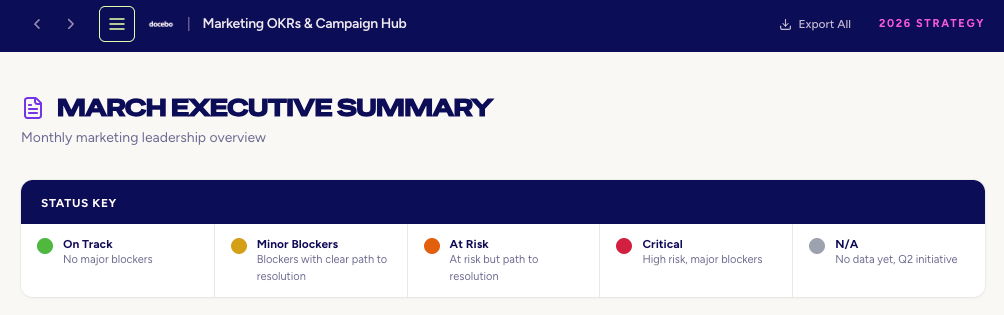
This is a new cadence and tool for us, and I’m unreasonably proud every time I click on the link. It’s a clear view of what marketing is focused on and how it is performing before anyone has to ask, because they have to wonder what’s going on.
I've worked at companies where marketing and sales operated like two different teams. In that type of environment, trust will slowly erode due to a thousand small information gaps.
It sounds glamorous and LinkedIn fodder-ready, but it’s not. We’ve changed/adjusted it four different times since we launched it at the beginning of this year. But that’s not the point. We defined a process that led to a commitment to keep everyone current, all the time, so that nobody in a position of leadership ever has to say, “I didn’t know about that.”
Most of the time, nobody notices when you're doing it right. They only notice when you're not. Don’t let it happen.
Lesson 2: Context is everything.
I had an assumption coming into this year that AI would be about building! Get the team building. Vibe-code the HELL OUT OF EVERYTHING. Ship tools that support your workflows. Move fast. CREATE! And we’ve done that. I’ve cleared time for the team to have build days to clear their calendars, and there were some genuinely impressive things that came out of it.
And then I learned one important lesson… the build doesn’t matter without the context underneath it.
No-brainer, right? I thought so, but only after it hit me right in the damn face.
Your team can build five different ICP tools. They can build competitive intelligence tools, personalization tools, outreach tools, content tools. All of them useful in some part of the team. But if those tools aren't syncing back to one central location (the source of truth that’s updating regularly) you haven't solved the actual problem or built a system. You've built five expensive experiments that slowly die as the data inside them goes stale.
And we don’t want the brilliant tools to die.
Context is what the AI is actually pulling from. And most of the time, the context is a mess.
We’ve spent the last couple of weeks thinking about this problem. What’s the foundation that everything else needs to plug into? What's the central layer that keeps everything current, that means a tool built in June is still useful in November because the data underneath it has been continuously updated.
100% less exciting than the question “What should we build?” This is especially true for creative, move-fast/break-things marketers.
The second lesson: you can't just turn teams loose to build and expect the good stuff to surface on its own. Our second AI Build Day worked better than the first because we came in with structure: Here are the workflows that are still painful, and here is where we are losing time to older, unproductive processes.
Learning how to build and test this new technology matters, and before you build anything meaningful with AI, you have to be honest about the quality of the context layer. And again, like most things in life, the model is only as good as what it's working with.
Lesson 3: Keep that gut instinct with a healthy slice of data
Here's the thing about building all of this. It will change how you use your gut (which I happen to be very, very good at). :)
I used to make gut calls on most things (shhh) and there were quite a few that I shouldn’t have. I’m not talking about the brand or creative direction decisions, I believe those will always be about feeling and good taste. It was more focused on everything else: pipeline forecast, budget, headcount, resourcing, etc. Things that actually had real data attached to them, and I didn’t slow down enough to look. And most of the time, the gut was right, but other times, I was wrong.
And I just kept moving.
But over this past year I’ve realized that all this process/infrastructure we’ve put in place, it protects your gut from itself. When you have the rhythm nailed, you stop burning hours and money on things you don’t need.
My instinct is still my secret weapon because I’ve spent the last 20+ years building it. Now, it’s more powerful because I’ve married it with the data. When a question comes up in a board meeting or an exec review, I'm not reconstructing an answer from memory or going with my best guess. I know. We know. Because we built a system that makes knowing the default state instead of the exceptional one.
I said this in a coaching conversation recently and it surprised me a little when it came out: the goal isn't to eliminate gut decisions. It's to protect them for the moments that actually need them.
A year in, I think that's the most important lesson.
And now we are in year two.
I still have imposter syndrome. I still have the constant head trash, whispering sweet nothings in my ear. They are just different things than twelve months ago. I still make mistakes. I still catch myself asking for permission I don't need. I still look at our AI workflow and see more gaps than wins sometimes.
But I know what the infrastructure is supposed to do. I know what context actually means. And I have a pretty good idea of what my gut is for.
That's more than I came in with.

Sleeping at Last - Ryan O’Neal - one of my favorite lyricists
We Are All Hunting for Something
I wrote about this on LinkedIn and felt it deserved a longer thread here in the Revenue Diaries. It’s about a Sleeping at Last lyric I’ve loved since initially discovering the band in the early 2000s
"We are all hunters hunting for something that makes us OK."
If you know it, we are friends forever. It's one of my favorite lines from any song on planet earth. I think about it constantly. I'm even planning to put it on the tattoo sleeve I've been talking about getting for 10 years. (Still talking. Still planning. Still hunting for the best artist. Haha, you see the irony, right?)
I keep coming back to it because it's the most honest thing I've ever heard about the way I'm wired. And maybe the way you're wired too.
Because I'm always hunting. The next win. The next milestone. The next goal. The next version of whatever I'm trying to build. The next thing that proves I'm moving in the right direction.
It's pretty exhausting.
And for a long time, I thought the answer was to stop. Be present. Be grateful. Settle into contentment.
But I don't think that's right. And I've stopped pretending it is.
On the Difference Between Ambition and Restlessness
Here's what I've figured out, at least for now: there are two kinds of hunting: Ambition and restlessness.
Ambition is about building. You are constantly searching for something worth making. It’s the thing that gets you out of bed at 5 am (or 7 am if you aren’t crazy like me). It’s the thing that pulls you forward. Ambition has a direction and it knows what it is chasing… well, hopefully. :)
Restlessness just moves. Almost reminds me of any mindless zombie in a horror flick. It hunts because standing still feels dangerous (or it needs to much on some delicious brains). It confuses motion with progress. It makes you scan job boards six months into a role you might actually love but didn’t give a chance, or start three new project when the two you have are working, or sit at dinner with your family and find yourself mentally somewhere else... solving a problem that hasn't happened yet.
I do both. Sometimes in the same hour. Again, it’s exhausting.
The problem? Restlessness is the wolf in sheep’s clothing. It disguises itself as ambition. It feels like productivity and has the same energy. But ambition tends to leave something behind; restlessness just leaves.
As a leader and executive, I’ve been professionally trained to be restless. The job almost requires it. Haha. You're always hunting for the next crisis before it becomes one. Always being reactive to something, or trying to be proactive enough that you never have to be (more on that in my year one lesson in this email). You're rewarded for never sitting still, for always having an answer, for never being surprised.
It’s a useful superpower until it turns into kryptonite. And that’s officially the only Superman reference I will ever make in this newsletter.
At some point, the hunting becomes the default. You stop being able to turn it off. The skill that keeps you ahead at work is the same thing that keeps you half-present at home, half-committed to the choices you've already made, always measuring what you have against some future version of yourself.
Watching Kids Grow Up While Your Brain Is Somewhere Else
My kids are getting older. (I know. Everyone says that. Bear with me.)
But it’s absolutely mentally exhausting for someone who constantly hunts. Because kids don't wait for you to be ready and time doesn’t wait either. And if you're not paying attention, if you're three steps ahead in your own head, you look up one day and realize the moment already happened.
I think about it constantly and it’s important I model for them what has helped me later in life pertaining to the hunt.
I want to teach them to want things and not to be satisfied with the first version. That restlessness, when it's pointed right, is a superpower. It's the thing that built every good thing I've ever been part of.
But they must also learn to commit, and go deep on something they are passionate about. The version of me I want them to see is someone who knows why he's hunting. Not just someone who can't stop.
That's hard to model when you're still figuring it out yourself.
So, I guess the question is… what are we actually hunting for? Because the lyrics are great, but the word that stands out the most is the end.
"We are all hunters hunting for something that makes us OK."
Not great or fulfilled or successful… just OK.
Which means most of us, at some level, are hunting because we don't quite feel OK yet… a constant feeling that if we just hit the next thing, close the next deal, reach the next milestone, nail the next quarter... then we'll feel OK enough to be… OK?
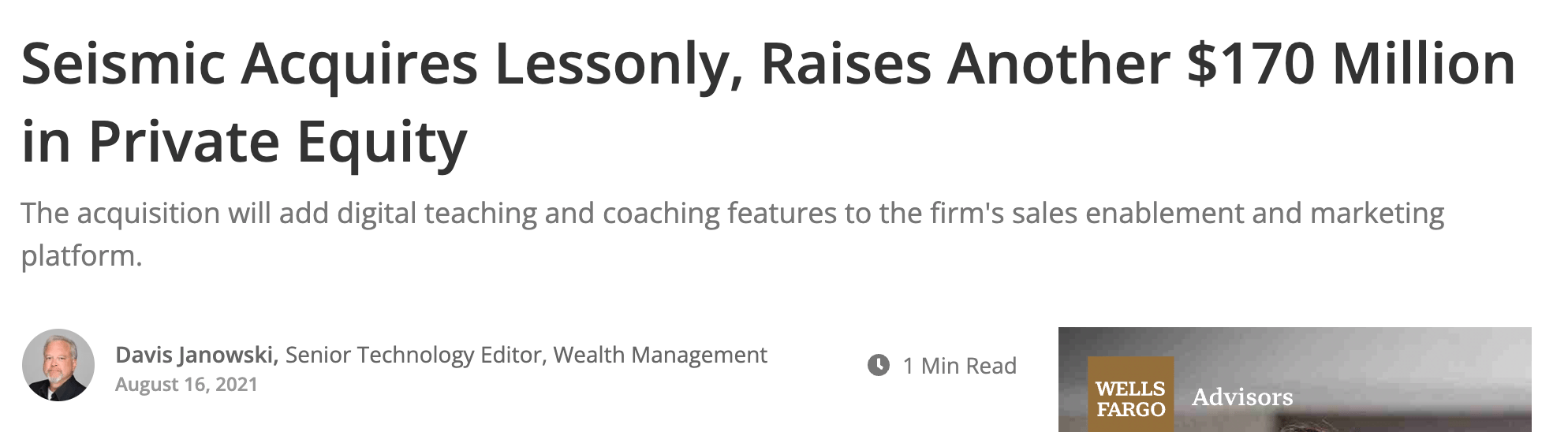
Do you know what happens when you hit? I know. I’ve been part of a couple of acquisitions, with the first meaningful one being Seismic's $300M acquisition of Lessonly in 2021.
I felt the joy for a day, maybe two days, you would need to ask my wife. 🙂 And guess what happened? The gap reopened, and the hunt started again.
Sounds exhausting, right?
I don't think the answer is to stop hunting. I've tried. It doesn't take. And honestly, I'm not sure a version of me that stops hunting is a version I'd recognize or even want.
But I've started asking a different question. Not what am I hunting? but why am I hunting for this particular thing?
Is it ambition? Is it something I've actually chosen, something I'm building toward, something that goes deeper than the next milestone?
Or is it restlessness? Is it fear? Is it the need to prove something to someone who probably stopped watching years ago?
I don’t have a clean or clear answer, but the thought is sometimes the only thing you need to drive change.
I'm still in the middle of this one. I'm not sure you ever get to the other side of it... not if this is how you're built. But I think the goal isn't to stop hunting.
The goal is to hunt for something worth finding.