- Revenue Diaries
- Posts
- Revenue Diaries Entry 62
Revenue Diaries Entry 62
This work is f****** hard and how you work is super important.

Kyle Lacy
January 25, 2026
This week’s entry is a little longer because, well, a ton of stuff happened over the last couple of weeks. This week? How about I give it to you in emojis? 😮💨 😭 😂 🚀 🔥.
It was one of the most stressful weeks of my career and the most rewarding. Let’s break it down in a quick timeline:
January 8th - We launched our new brand to the world. An eight-month project finally coming to fruition.
January 20th - Announced the acquisition of 365Talents, a 55-person skills intelligence startup based in Lyon, France.
January 21st - Welcomed 500 teammates, partners, and friends to Atlanta for our Revenue Kickoff
Keep in mind. We’ve been building towards the brand launch over the last six months while maintaining some secrecy about the acquisition.
So, this week’s entry is going to focus on the HOW. I’ll walk you through my key tips to a successful RKO, and more detail in how the marketing team works.
But first, I want to talk about the true cost of entry when you become a leader, because it’s not easy. Sure, you get paid for it, but I don’t think people fully appreciate how hard the job is and how rewarding it can be… if you do it right.
Because leadership is f****** hard. Keep scrolling.
♥️ kyle

On Why Leadership is F****** Hard
Many people want to be leaders but don’t understand the true cost of entry. They want to be a VP, SVP, CMO, CRO, or CEO. The executive. The leader of teams. The person in the room making the calls.
Are you sure?
You don’t just own your work anymore. You absorb pressure from your team. Expectations from peers. The weight of the board and the business.
You also live in constant context switching. Strategy to people issues. Budget to culture. Vision to execution. One conversation is about growth. The next is about morale. The next is about risk. You rarely get to stay in one lane for long.
You’re expected to stay steady when things are falling apart or unclear, and make decisions without complete information.
From the outside, leadership can look like influence and progress. I get it. That’s part of it. From the inside, it’s constant judgment, emotional control, accountability, and mental load.
I love the work. But loving it doesn’t mean ignoring the toll. It means learning how to carry it. Over time, this is what’s helped me handle the hard parts of leadership:
PS: You can find most of this in my past entries. There were too many to link. 🙂
I write to slow my thinking down. Yep. This newsletter helps. It’s to get the noise out of my head and force the clarity needed to survive.
I replace emotion with evidence. What do we actually know? What’s true? What’s just noise? Data backs creativity and opinion.
I over-communicate. My CEO should never be surprised. Good and bad. Shorter updates. Quick thinking. It doesn’t have to be perfect, but it should inform.
I share before ready. Waiting for perfect thinking makes the stress worse. Sharing before something is ready also allows you to bring people along for the ride. The benefit? Alignment.
I narrow my focus to what I actually own. What’s my decision? What can I influence versus absorb? Focus. Focus. Focus. Well, I try.
I rely on a small circle of peers who tell me the truth and help me reality-check my own stories.
I exercise. Get out there and sweat. It will clear your mind and make you a better human. Highly recommend OrangeTheory if you haven’t tried it.
I accept stress as part of the role, not a failure. It’s the cost of responsibility and caring.
I name the fear rather than avoid it. Writing it down makes it smaller and easier to manage.
Yep, it’s hard. Yep, there are days when I hate it. But there are overwhelmingly more days when I love what I do. It’s not about eliminating the stress; that’s part of the job. It’s about carrying it well, so you don’t burn out.
If you decide to chase the title, ask yourself: Are you ready to carry what comes with it?
On How We Work
Whew. RKO. CKO. SKO. PKO. If you don’t know the acronyms, that’s okay. All you need to know is (RCPS)KO = exhausting. Not to mention, adding a brand launch and an acquisition.
And as I’ve mentioned before in this newsletter, we compressed three major projects in a three-week timeline. I’m not sure I’ve ever experienced (or witnessed) the sheer volume of work that’s been thrown at this team over the last couple of weeks.
But we did it, and we did it in the right way. Did things break? Sure. Did we pull late nights and early mornings? You betcha (ht: Frances McDormand). Did people take breaks to reset? Yep.
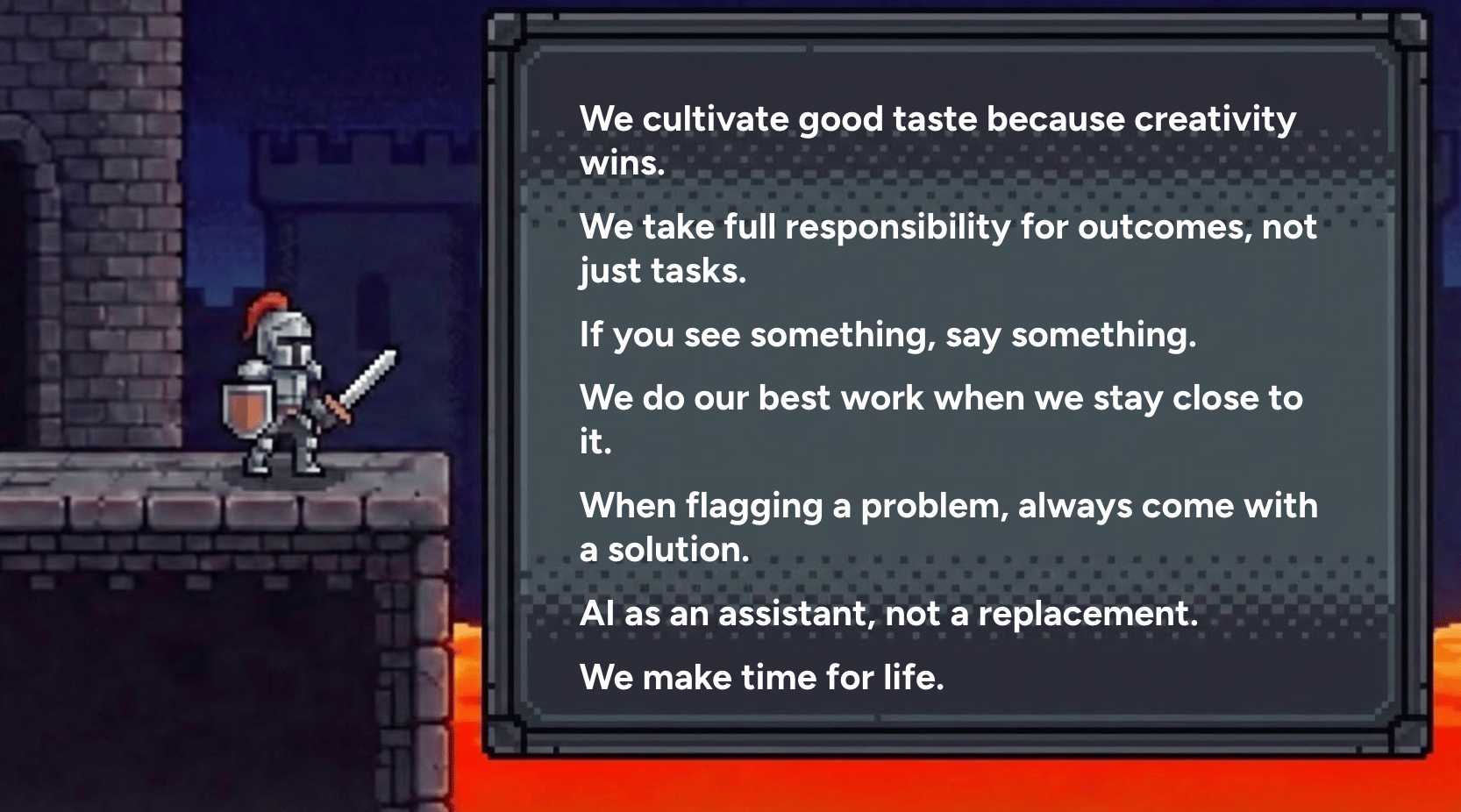
At the beginning of our breakout day at RKO, it was important for the marketing team to review our “How We Work” philosophy. You could say they are a set of marketing team values, but it’s more around how we actually accomplished everything over the last month without losing our sanity.
Most important callout: I didn’t invent these. I witnessed them. Thought it would make sense to share with you.
We cultivate good taste because creativity wins: The only competitive advantage we have is our taste and how we apply it creatively. B2B marketing can be underwhelming and boring, but we strive to make it interesting. We obsess over the experience above all else. When things are moving at breakneck speed, it’s easy to ship work that’s underwhelming; we try not to.
We take responsibility for outcomes, not just tasks: You can’t hide behind a checklist or Asana board on this team. Checking the box is never the end of the project or the campaign. The real question was whether it worked for sales, for customers, and for the moment it was being used. It’s important to manage the entire project, not just the checklist. You are responsible for the outcome as much as you are for shipping the assets.
If you see something, say something: Don’t ignore the cracks. Small cracks can turn into real problems. The most important part? This should apply to all initiatives, not just the ones you are responsible for.
We do our best work when we stay close to it: This one is pretty simple. We do the work. There are no ivory towers at Docebo. C-suite to VP to Director to IC, everyone is doing the work. We don’t have the patience for 100% outsourcing. When you are moving 100 mph, outsourcing gets expensive fast, and for the wrong reasons. Staying close to the work makes you better and strengthens the entire team.
When flagging a problem, come with a solution: Don’t complain without understanding the problem. It’s about forward motion and working with a team. If you are going to point out an inefficiency, help solve it.
AI as an assistant, not a replacement: AI is everywhere. We use it constantly. I believe it’s made our pace passive, but it doesn’t make the calls. You shouldn’t outsource your creativity to the robot.
We make time for life: This was a Lessonly value, and I’ve used it for every team since. Self-explanatory, right? It’s giving the team permission to take breaks. Go for a run. Spend time with your kids. A collective breath is sometimes all that’s needed to survive and thrive. I’m going to stop there because I’m starting to sound like Tony Robbins.
Is that all you need to deliver brilliant work? No, but it helps to point your team in the right direction. It’s about protecting what’s working before the next wave of craziness hits.
This team isn’t getting better by accident. We are shaping how this team operates in real time. I’m just glad you all are joining me in the journey. The fact that we came out the other side with trust intact, work we’re proud of, and people who still want to do it again says more than any retro ever could.
This is how the marketing team at Docebo worked through one of the most stressful and compressed periods I’ve seen. If any of it helps you build or steady your own team, steal it.

On 5 Decisions For an Unforgettable Revenue Kickoff
Yep. I was in Atlanta all week for our Revenue Kickoff. Check out the highlight reel if you want a little taste of the awesomeness. We had over 400 Docebians and partners in the room.Two full days together. Travel on Tuesday, then a smaller leadership summit to get aligned before the broader group arrived. Wednesday morning started with the keynote. Product, sales, and marketing on stage together, setting direction and context. That night, teams split off for dinner. The following day was reserved for breakouts.
When we started planning the event, we kept coming back to three ideas. Alignment, connection, and celebration. Decisions about who belonged in the room, how long sessions should run, and where to spend energy all flowed from that.
Who Should Attend RKO?
The first decision was who could attend the event. Revenue kickoff is often treated as a sales gathering with some adjacent support. I always thought that framing was crazy. We create revenue through a system, not a specific function.
PS: I also think the same thing about President’s Club. Why don’t we have supporting functions join the sales team? More on that in a later newsletter. I digress…
Sales brings in the deal, but marketing shapes demand; customer success drives adoption; professional services ensures delivery; legal gets the deal done, and finance supports the entire process. So, we tried to bring everyone. When we said revenue kickoff, we meant it literally. People who land, support, and retain customers were all in the same room, hearing the same message.
That choice changed the feel of the event. Teams that usually interact through tickets or handoffs were suddenly sitting next to each other. It was awesome.
Get Your Partners Involved
Partners were part of that system too. We involved them early and meaningfully. Partner support allowed us to invest more deeply in the experience itself. More space to design something people would actually enjoy being part of. I think about revenue kickoff the same way I think about a user conference. It deserves attention and craft. The audience may be internal, but their expectations are not lower. They notice effort. They notice shortcuts too.
Spend Time on the Theme (Seriously)
The theme gave everything a backbone. We landed on Game On early, and it immediately simplified decisions for the creative team. 8-bit inspired slide designs. Gaming elements were built throughout the hotel. We even had arcades! Experience matters. When people walk into a space that feels intentional and well-designed, they engage differently. Energy rises without anyone having to manufacture it. I don’t need anymore of the, “I can’t hear you?!?!?!!”
Design Your Team Breakout Around the Work
In the marketing session, we spent some time reflecting on what we learned from the previous year, but most of the time was spent planning. Campaigns for the first half of the year. What tactics do we need to consider and the resourcing to support. Tradeoffs we would need to make as a team. When you only have the full group together once or twice a year, that time is too valuable to waste. Team bonding happens naturally when people solve real problems together.
Obsess Over Your Internal Events As much or more than your External
Internal events shape culture faster than most of us realize. The way you design them signals how much you value people’s time, attention, and contribution. Employees experience the brand every day through these moments. When internal experiences are rushed or underinvested, culture will slowly erode until there is a shell of shit. When they are treated with care, people will love you for it.
I will always love Revenue Kickoff because it brings everyone together in a meaningful way. And if done correctly, it will make a statement on how true value is created and who is responsible for creating it. Designing that experience with intention is not a nice-to-have…
It’s your damn job.