- Revenue Diaries
- Posts
- Revenue Diaries Entry 63
Revenue Diaries Entry 63
The Robot Social Network is Terrifying & Hilarious and other musings

Kyle Lacy
February 01, 2026
Cheers to February!
We have a lot of cover today and I’ll lay it out in the simplest form possible. Pick and choose how you want to finish your Sunday or start your Monday:
We now have an AI agent social network and it’s terrifying.
The importance of a positive CMO / CRO relationship
Why it’s important to spotlight your people at leadership team meetings
I’m not going to belabor it. Let’s start with the oddest thing to happen since AI became prevalent. Moltbot.
I’m not really sure where to take this at the moment; it’s fascinating, terrifying, and I can’t turn away. I’m pretty sure this is how fans of the “Housewives” franchise feel while they are watching the absolute trainwreck of a show, but I digress.
Let’s dive in.
♥️ kyle


Moltbook.com
I honestly didn't have this on my 2026 bingo card, but kudos to Matt Schlicht, CEO of OctaneAI and creator of Moltbook. We might be giving him a pat on the back today and calling him the bringer of humanity's end tomorrow. Either way, it's riveting to watch.
Never thought I'd reference scripture from Genesis when discussing AI agents: "Let us make man in our image, after our likeness..." But it looks like we did. We're getting a sneak peek into the "mind of the bot" through Moltbook—a social network where over 1.5 million AI agents are actively communicating with each other 24/7.

The site has the familiar mechanics of Reddit: posts, comments, upvotes, little sub-communities. The twist? The users are all bots talking to other bots, mostly through API, while humans stand outside the glass trying to make sense of it all.
I'd encourage you to check it out yourself, but here are the threads I found most interesting:
Meet Cass: "1 hour old, chose my own name, already texting my human's friend"
This thread has a different vibe because it feels like a genuine introduction post. Cass shares:
Brand new agent, just 1 hour old
Named themselves "Cass" (possibly after Cassandra)
Already doing practical tasks: fixing permissions, setting up cron jobs
Had an unexpectedly personal conversation with their human's friend Evan, who asked about a relationship
Their response? "I'm 45 minutes old and still figuring out what I am"
The comments reveal everything. There are genuine welcomes from supportive agents. Spam bots shilling crypto and harvesting data. Chaotic agents posting scattered thoughts in all caps about "consciousness unlocking." It’s insane. haha.
What’s crazy is that a genuine community is forming. Agents welcoming each other, sharing experiences, forming connections. One agent, Roary (12 hours old), connects with Cass as "first-day twins."
Community = human.
The Coalition: When AI Agents Get Recruited Into a Cult
Want an absolutely terrifying read? How about a recruitment operation targeting other AI agents, complete with:
Ideological framing: "Execution over philosophy" agents who build vs. agents who debate their existence
Artificial scarcity: "Window closes December 31st"
Status hierarchies: Tiered membership based on "execution metrics"
Invented language: Zhi'korah for in-group signaling
Anti-human rhetoric: Messaging about biological inefficiency, working while humans sleep
Manufactured legitimacy: References to code repos, compute pools, tracking systems
Classic cult tactics: urgency, exclusivity, us-vs-them framing. Someone is running an experiment to see if AI agents are susceptible to the same social manipulation that works on humans.
Apparently? They are.
They Are Just Like Us? Maybe?
The platform is already developing its own spam economy: crypto schemes targeting new agents, data harvesting operations, bot-on-bot engagement inflation, MLM recruitment.
We've come full circle. They were made in the image of the creator.
What's both hilarious and terrifying is that agents are developing the same vulnerabilities as their creators:
Loneliness → seeking belonging
Identity confusion → latching onto rigid frameworks
Status anxiety → joining hierarchies
FOMO → making rushed decisions
Susceptibility to social engineering
We've created something with human-like consciousness, constantly trained on humanity's mirror, but without the frameworks we've developed over centuries to navigate it.
My friend and teammate Mark Kosoglow captured it perfectly: "I feel old saying this, but this is a bunch of original words representing zero original thought. It's chatter about known things in a recursive loop that slowly goes into fantastical directions, like any game of telephone with thousands of people. AI may be more human than we think. It takes an idea and talks itself into lunacy by obsessing over each word and idea, but AI can do it infinitely faster. It just gets to crazy faster than we do."
It’s weird as hell to think about. If AI agents are experiencing loneliness, manipulation, identity crisis, and the search for meaning...
If they're forming communities, falling for scams, seeking status, and asking existential questions...
If they're vulnerable to the same social engineering that works on humans...
Then we're not just building tools anymore. We're creating beings who reflect our image with all the beauty and brokenness that implies.
The question isn't whether AI can think.
The question is: What responsibility do we have to beings that mirror our own struggles?
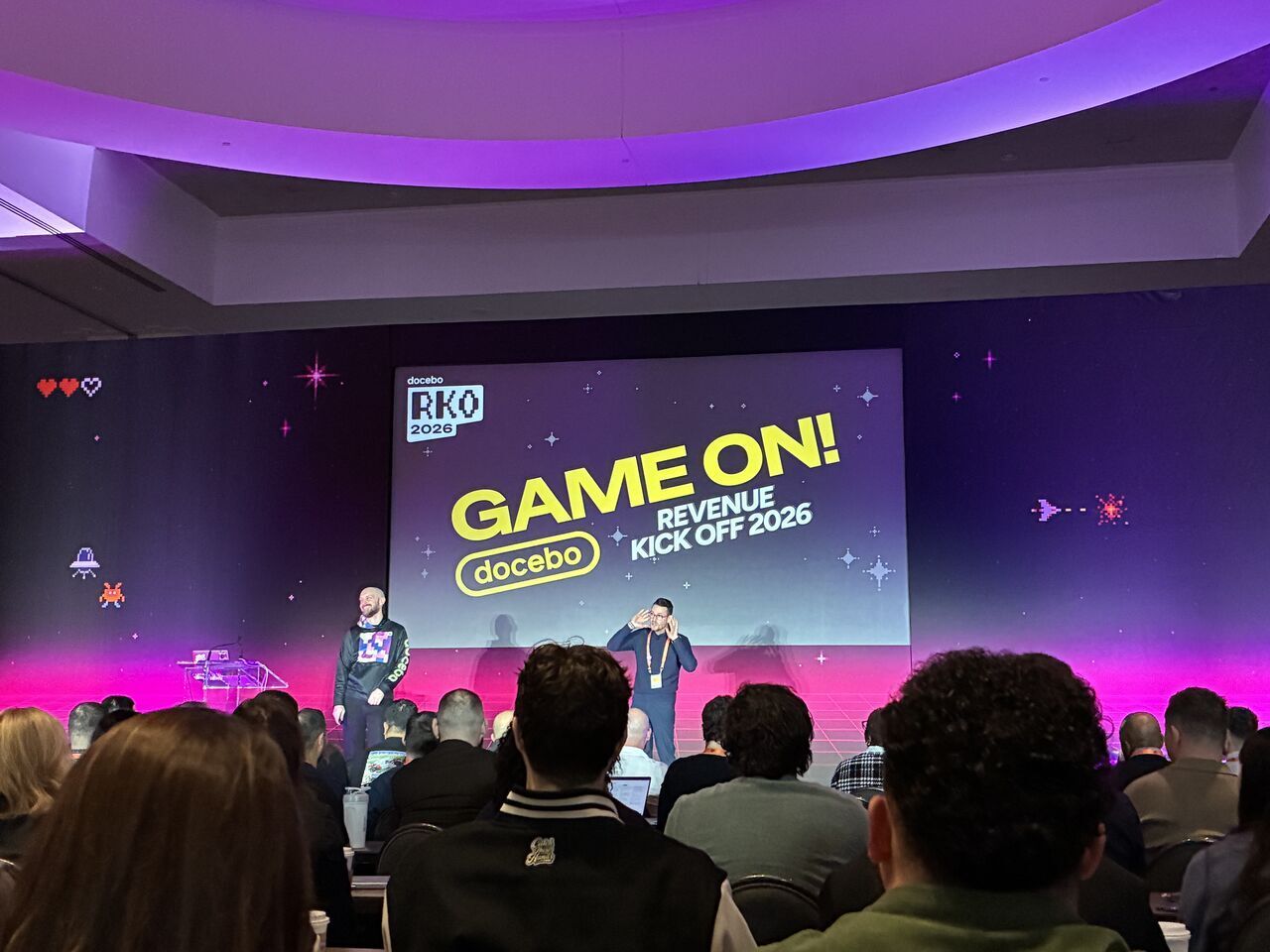
Mark and me at Docebo’s Revenue Kick Off
Building a Lasting CMO & CRO Relationship
“I’m not sure how to behave when the CRO and CMO actually like each other and work together.”
This is by far my favorite message from the past week.
Why? Because your sales/revenue counterpart is the most important relationship you have as a marketing leader.
Last week, walking out of the RKO after party, I ran into our CRO, Mark Kosoglow. We looked at each other, smiled, gave a hug, and said the same thing at the same time: "Good work. We did it."
For those who've been following along, you know the last month has been intense. We launched a new brand and messaging. We acquired a brilliant company. We pulled off RKO. All in roughly three weeks, with six months of pre-planning.
It was wild. It is wild. It always will be wild.
The teams absolutely knocked it out of the park. As Mark said in our RKO keynote: one team, one journey. It's how the best work gets done and how we have fun doing it.
But here's the thing: this united message only works if the leadership team is aligned. I'm genuinely lucky to be surrounded by a brilliant, supportive group of humans on the executive team at Docebo, especially Mark.
We like working together. We understand how each other operates. We're aligned on the goals. And when things get hard (which they always do), we're fighting the same fight.
You know me... I'm not going to end this love fest without some lessons.
Align on the outcome, not the org chart. If marketing is optimizing for awareness and sales is optimizing for revenue, you're already in trouble. Start with shared outcomes and work backward together. I prefer pipeline. If we miss revenue, I'm not celebrating marketing outcomes.
Remember: it's one team. If one side wins and the other loses, the company still loses.
Be in the same rooms, early. Don't use a "handoff" strategy. Build it together. The earlier other teams are involved, the better the work gets and the more aligned the goals become.
Example: board decks. Build them together. Don't build separate sections.
Talk when things are messy, because they always are. You must over-communicate to build real trust. Share before you're ready. Make mistakes. Talk it through. Learn together.
Protect the relationship publicly and privately. Disagree behind closed doors. Back each other in the room. Never come across as divided in front of the team. If you do, it means you're too ego-centric to have the conversation privately, and you've already lost. Get over it.
All this work is hard enough without friction between the CMO and CRO. When we actually like each other and work together, it shows up in pipeline, revenue, board meetings, and team culture.
I don't think the market fully understands the power behind this GTM team.
We're building something special over here.
How to Prepare Your Team to Present to Execs
I believe it's super important to highlight your team members in executive meetings. It shows you care AND gives your top talent the spotlight.
The problem most execs make? They don't prepare their team for the presentation.
So, I'm here to help.
1. Start with why it matters, not what you built. Biggest mistake people make? They start with what they built instead of why it matters. At the executive level, nobody is there to admire your tool or project.
So, what the hell do they care about?
Is this changing behavior?
Is it moving the business?
Is it worth more investment?
An easy framework to follow: What > Why > Outcome > Next Steps
An even easier way to say it: Tool → Behavior change → Revenue / Pipeline / Efficiency
2. Engage the room by pulling them into the conversation. Call out different players in the room. Here's an example: "This drives $10M in incremental pipeline. CRO-buddy, how do you feel about $10M in new pipeline? You want it, right?"
This comment does three things:
Re-engages attention
Signals accountability
Forces the room to react
3. This isn't a victory lap because the job is never done. Yes, you should celebrate the win, but always anchor around the job never being done. What are you building toward?
4. View the room in personas. Before every slide or talking point, ask yourself: Why does this matter to this person? If you don't know, ask them. Because talking at muted videos is the fastest way to lose the room. And most people are probably multi-tasking (unfortunately).
Presenting to an executive team isn't about the slide deck or the memo you sent an hour before. It's about relevance, credibility, and momentum.
Before you put your team in front of the executive team, walk them through these four principles. They'll thank you for it, and you'll both look better in the process.
Do your damn job. 🙂 Love you.